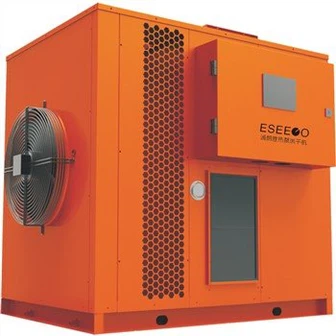

Heat pump Drying VS Solar Drying
Heat pump drying and solar drying are two common methods to dry various materials and products such as grains, fruits, vegetables, meat, and clothes. Heat pump drying is a type of mechanical drying while solar drying is a type of natural drying. In this article, we will compare heat pump drying and solar drying in terms of their benefits and drawbacks, energy consumption, efficiency, and applications.
Benefits and drawbacks
Heat pump industrial heat pump dryer has several benefits over solar drying such as faster drying time, higher quality, and consistent output. Heat pump dryers can control the temperature, humidity, and airflow inside the drying chamber, which results in shorter drying time and better product quality. Heat pump drying is also less affected by external factors such as weather and sunlight, which makes it more reliable and predictable.
However, heat pump commercial dehydrator also has some drawbacks such as higher capital and maintenance costs, complex operation, and higher energy consumption than solar drying. Heat pump dryers need electricity to operate compressors, fans, and sensors, which makes them less energy-efficient than solar dryers. Heat pump dryers also generate heat, which can lead to higher energy bills and environmental impact.
Solar drying, on the other hand, has several benefits such as being cost-effective, environmentally friendly, and easy to operate. Solar dryers use the sun's energy to dry products, which makes them free to operate and maintain. Solar drying is also eco-friendly since it doesn't produce harmful emissions or waste. Solar drying is also straightforward to operate, as it doesn't require complex controls or equipment.
However, solar drying has some drawbacks such as longer drying time, lower quality, and variable output. Solar dryers are highly dependent on weather and sunlight, which can result in longer drying time and variations in product quality and quantity. Solar drying also requires ample space and access to direct sunlight, which may not be possible in some regions or situations.
Energy consumption and efficiency
In terms of energy consumption, heat pump large commercial dehydrator requires electricity to power compressors, fans, and sensors. The energy consumption of a heat pump dryer depends on several factors such as product type, humidity, temperature, and airflow. However, heat pump drying is generally more energy-efficient than other types of mechanical drying such as convective or infrared drying. Heat pump drying can achieve high energy efficiency due to its ability to recycle heat and moisture within the drying chamber.
Solar drying, on the other hand, doesn't require any electricity to operate, but it requires sunlight to dry products. The energy efficiency of a solar dryer depends on several factors such as solar radiation, ambient temperature, airflow, and product properties. Solar drying is generally less energy-efficient than heat pump drying, but it can still be cost-effective and eco-friendly in certain situations.
Applications
Heat pump food dehydrator is commonly used in industrial and commercial settings where high-quality, consistent output is required. Heat pump drying is suitable for drying a wide range of products such as fruits, vegetables, grains, meat, and clothes. Heat pump dryers are also suitable for large-scale operations or areas where direct sunlight is not available. Heat pump drying can be used in conjunction with other drying methods such as microwave, infrared, or convective drying to achieve optimal results.
Solar drying is commonly used in rural and remote areas where electricity is not readily available or cost-effective. Solar drying is suitable for drying a range of products such as fruits, vegetables, grains, meat, and fish. Solar dryers are also suitable for small-scale operations or household use where direct sunlight is accessible. Solar drying can be used with various types of solar dryers such as direct, indirect, or mixed-mode dryers to achieve optimal results.
Conclusion
In conclusion, heat pump drying and solar drying are two different methods of drying products that have their benefits and drawbacks. Heat pump drying is generally faster, of higher quality, and more consistent, but it is more expensive and energy-intensive. Solar drying is generally cheaper, eco-friendly, and easy to operate, but it is slower, of lower quality, and more variable. Both methods have their applications in industrial, commercial, and residential settings, depending on the product, location, and available resources.